

AI Clause Extraction and Contract Risk Review Software
Extract clauses, key terms, obligations, and risk-related provisions across individual contracts or entire document sets.
Extract Clauses, Key Terms, and Risk-Related Provisions
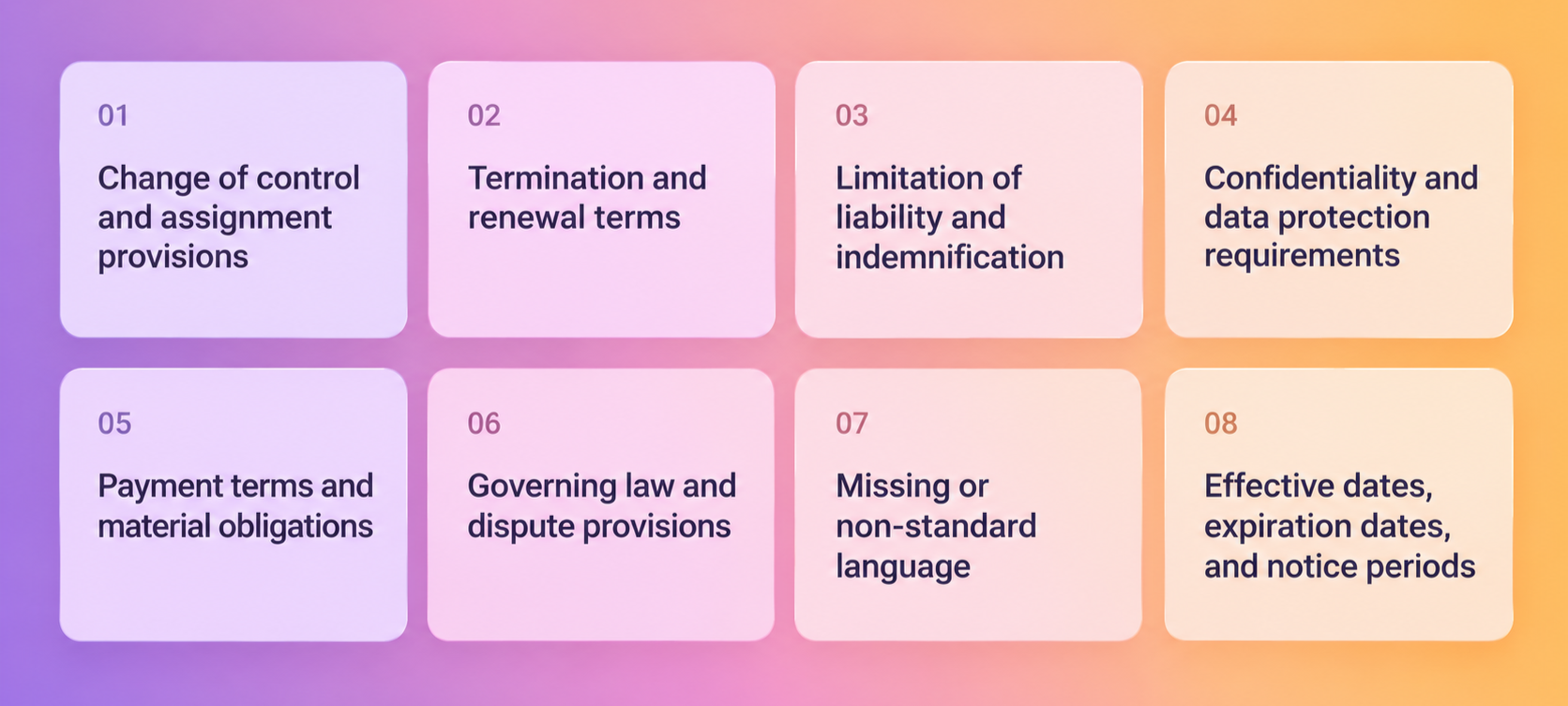
eBrevia Contract Analyzer helps legal teams identify and organize the information that matters across a contract set. This includes-
What is clause extraction?
Clause extraction software is a type of legal AI software that identifies and pulls specific clauses, provisions, obligations, and metadata from contracts.
For example, a legal team may want to know:
Which contracts contain a change of control clause?
What does the assignment provision say in each agreement?
Which agreements automatically renew?
Do any contracts have unusual termination rights?
Which contracts are governed by California law?
Are limitation of liability clauses missing or non-standard?
Clause extraction software helps answer these questions by locating the relevant language in each contract and organizing it into a structured summary or report.
Clause extraction is often part of a broader contract analysis software workflow, where teams extract data, compare provisions, identify risks, and export results for review, reporting, or downstream systems.
Why legal teams use clause extraction software?
High contract volume
Legal teams often need to review large sets of agreements across vendors, customers, employees, leases, or transaction documents. AI clause extraction helps identify the provisions that matter without manually searching each contract.
Time-sensitive review
In M&A due diligence, audits, compliance reviews, and risk assessments, teams often need answers quickly. Clause extraction software helps legal teams find key provisions faster and move from document review to legal analysis.
Inconsistent outputs
Different reviewers may summarize the same clause differently. A structured clause extraction workflow helps create more consistent outputs across documents and reviewers.
Difficult reporting
Legal teams often need to deliver results in a clear format, such as an Excel report or summary table. Clause extraction software helps convert contract language into structured outputs that can be shared with deal teams, business users, or clients.
Limited visibility into obligations
Important contract rights and obligations are often buried across PDFs, Word files, scanned documents, and data rooms. Clause extraction makes that information easier to find, review, and report on.

Common use cases for clause extraction
-
During M&A due diligence, legal teams need to review large volumes of contracts quickly and identify provisions that may affect the transaction.
eBrevia can help teams extract and review clauses such as change of control, assignment, termination, consent requirements, exclusivity, most favored nation clauses, non-competes, governing law, limitation of liability.
This helps deal teams understand key risks and obligations before closing.
Learn more about a more scalable approach to M&A contract review.
-
Companies often have thousands of agreements across departments, vendors, customers, and business units. Clause extraction helps turn those contracts into a usable dataset.
Legal teams can extract renewal terms, expiration dates, termination rights, payment terms, key obligations, notice provisions, governing law, risk-related clauses.
This gives organizations better visibility into their contract portfolio.
-
When regulations, business policies, or risk priorities change, legal teams may need to identify affected contracts quickly.
Clause extraction software helps teams find contracts that include or lack specific language, like force majeure, data protection terms, audit rights, indemnity, limitation of liability, governing law, security obligations.
-
Lease review often requires extracting key terms from long and complex documents. eBrevia can support lease abstraction by extracting clauses and data points such as renewal options, rent terms, notice periods, assignment rights, and expiration dates.
-
Procurement and legal teams can use clause extraction to review supplier agreements for key obligations, risks, pricing terms, termination rights, and renewal language.
Contract risk is rarely determined by the presence of a clause alone. Reviewers may need to understand whether language is missing, unusual, inconsistent with a standard, or different from provisions found in similar agreements.
eBrevia helps reviewers locate relevant language, compare clauses across contracts, and identify potential deviations for further legal review. Each result remains connected to its source language so the reviewer can validate the finding before reaching a conclusion.
Identify Provisions That May Require Further Review
Manual review can work well for a small number of contracts, but it becomes harder as contract volume grows, deadlines get tighter, or multiple reviewers need to produce consistent outputs. Clause extraction software helps legal teams review more contracts in less time, reduce repetitive searching, standardize summaries, track review progress, maintain source traceability, and export structured results. It does not replace lawyer review. Instead, it helps legal teams get to the relevant language faster, organize their findings, and spend more time on the legal analysis that requires judgment.
Clause extraction software vs manual clause review
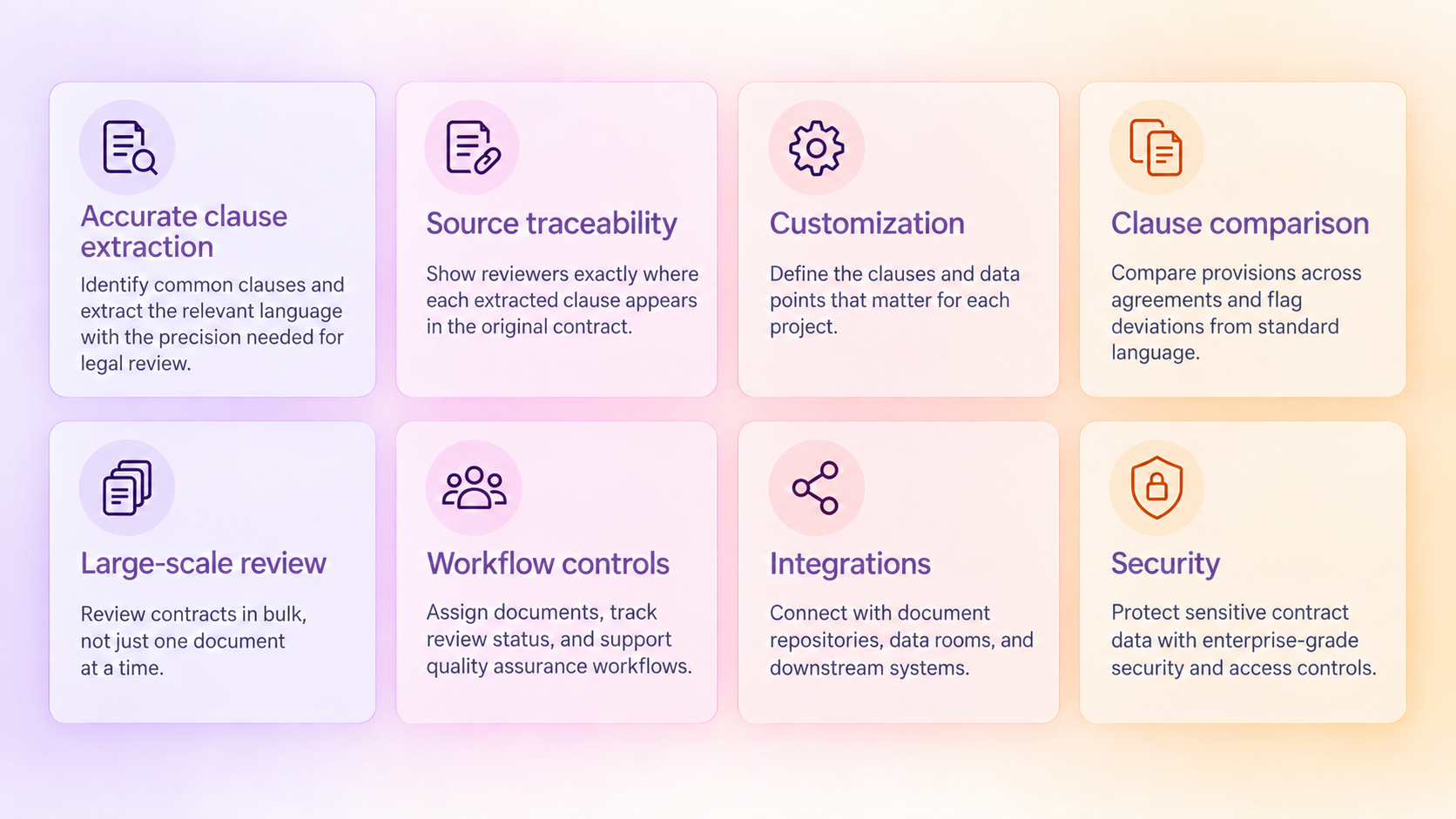
What to look for in clause extraction software?
The cost of contract review depends on more than the price of the software. Manual review becomes expensive when teams must repeatedly search contracts, summarize clauses, compare provisions, and prepare reports.
eBrevia Contract Analyzer helps teams use the same structured review process across an entire contract set. Teams can begin with pre-trained extraction fields, add project-specific fields when needed, review results against the original language, and export findings without manually building a separate summary for every contract.
eBrevia can support focused review projects as well as larger, recurring contract analysis needs. Pricing can be discussed based on contract volume, review scope, and the capabilities required.
A Practical Way to Scale Contract Review

-
Clause extraction should not be a black box. Legal teams need to see where each answer came from.
In eBrevia, extracted clauses are shown alongside the source document. Reviewers can click extracted language to jump to the exact provision in the contract. They can also edit results, add notes, delete incorrect extractions, or highlight missing language and add it to the correct field.
This helps legal teams move faster while still maintaining control over the final review.
-
Different legal projects require different clause sets. eBrevia supports this through forms and fields.
A field is a specific data point or clause that the system extracts from a contract. For example: Change of control, Assignment, Termination, Renewal, Auto-renewal, Governing law, Confidentiality, Limitation of liability, Indemnification, Force majeure, Effective date, Expiration date.
A form is a collection of fields used for a project or document type. A team reviewing leases may use one form, while a team reviewing employment agreements may use another. This allows legal teams to tailor clause extraction to the review they are running.
Most teams can start with eBrevia’s pre-trained fields. When needed, teams can also create custom fields for project-specific clauses or data points.
-
Some legal reviews require more than standard clause extraction. A team may need to ask a deal-specific, policy-specific, or compliance-specific question across a contract set.
With eBrevia Lens, users can ask natural language questions across contracts and receive context-aware answers. This helps teams adapt quickly when a new issue arises during review.
This makes eBrevia useful for both standard clause extraction and more tailored legal analysis.
-
Extracting clauses is only the first step. Legal teams often need to understand how clauses differ across agreements.
eBrevia helps teams compare provisions across contracts and identify deviations from standard language. This is useful when reviewing agreements against a preferred form, template, playbook, or fallback position.
For example, a legal team can compare termination clauses across a group of contracts and quickly see whether the language is standard, modified, or potentially risky.
This is especially useful for: M&A due diligence, template compliance reviews, repapering projects, vendor contract reviews, portfolio risk analysis.
-
Clause extraction software becomes more valuable when it helps teams see patterns across an entire contract set.
With eBrevia, teams can analyze contracts at scale by using: Similarity clustering, advanced filtering, dashboards, structured exports.
How eBrevia supports AI clause extraction?
Frequently asked questions
-
Clause extraction software uses AI to identify and extract specific contract provisions, such as termination, renewal, assignment, change of control, governing law, confidentiality, indemnity, and limitation of liability clauses.
-
AI clause extraction reviews contract text, identifies relevant provisions, and organizes the extracted language into structured fields. Reviewers can then validate, edit, compare, and export the results.
-
eBrevia can extract common contract clauses and data points such as termination, renewal, assignment, change of control, governing law, confidentiality, indemnification, limitation of liability, force majeure, effective dates, expiration dates, and other key provisions.
-
Yes. Clause extraction software is widely used in M&A due diligence because legal teams need to review large volumes of contracts quickly and identify clauses that may affect the transaction.
-
Yes. eBrevia supports custom extraction fields for project-specific clauses and data points. Teams can also use eBrevia Lens to ask natural language questions and capture additional information.
-
Yes. eBrevia allows reviewers to see extracted clauses alongside the source document and click results to jump to the exact contract language.
-
Yes. eBrevia helps teams compare provisions across agreements and identify differences from standard language, templates, or other contracts.
-
Clause extraction is a core part of contract analysis software. Clause extraction focuses on identifying and pulling specific provisions, while contract analysis includes broader workflows such as search, comparison, risk review, reporting, dashboards, and structured exports.
-
Clause extraction software is used by law firms, in-house legal teams, compliance teams, deal teams, procurement teams, and contract management teams.
-
Yes. eBrevia can export structured clause summaries and contract data for reporting, review, and downstream workflows.