
Inside the Executive Conversation on Contract Operations
What emerged from an off-the-record executive breakfast in London.
Senior leaders responsible for contracts and enterprise operations from global enterprises, financial services, professional services and high-growth technology companies gathered recently at the Rosewood London on Chancery Lane for an invitation-only executive breakfast hosted by eBrevia.
Introduced by EMEA Account Director Sophiya Volkova and led by eBrevia CEO and Co-Founder Adam Nguyen, the discussion brought together executives navigating a rapidly changing environment for contract operations, technology strategy and organizational transformation.
Held under Chatham House Rules, the conversation allowed participants to share challenges, priorities and lessons learned openly. Individual comments and company names remain confidential, but the themes that emerged reflected many of the questions facing organizations as they rethink how contracts are created, managed and leveraged across the enterprise.
The discussion was less about predicting the future of AI and more about understanding how organizations are adapting today.
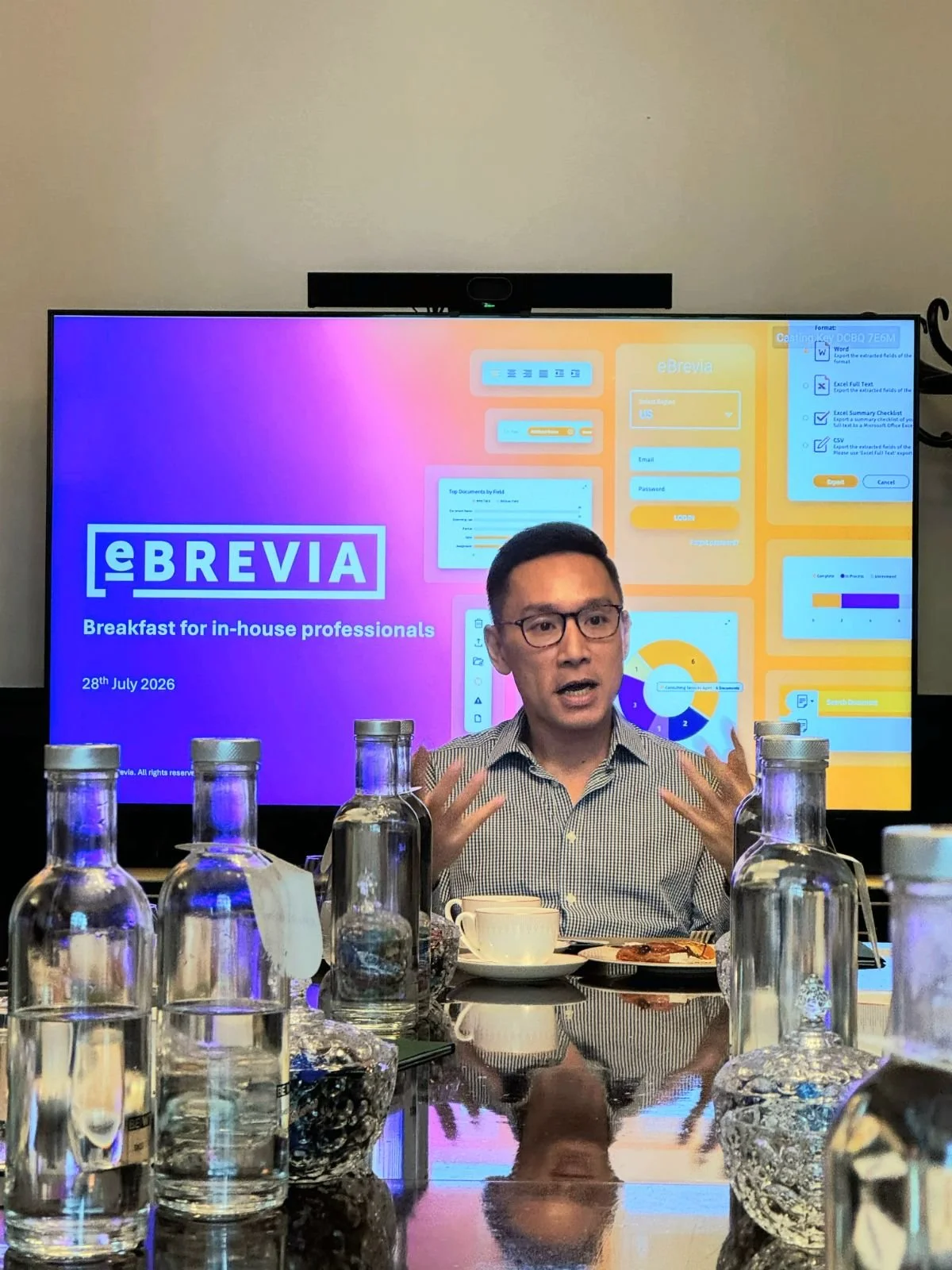
eBrevia CEO & Co-founder Adam Nguyen addresses senior leaders on utilizing AI to deliver value to contract work at scale .
One executive spoke of persuading senior leadership to invest in AI, characterizing it as "a lot of therapy.” Others around the table immediately recognized the challenge. The conversation repeatedly returned to the human side of technology adoption: building internal alignment, developing governance frameworks, securing investment and helping teams understand where AI can create meaningful value.
That challenge is reflected across the broader corporate landscape. The Thomson Reuters Institute's State of the Corporate Law Department Report has highlighted the increasing pressure on legal departments to deliver more strategic value while managing resource constraints, with technology investment becoming a growing priority for many organizations. The challenge for leaders is translating that investment into practical improvements in how work gets done.
For many participants, that starts with understanding existing processes.
One executive described building an internal application to generate nondisclosure agreements, only to discover that document creation represented just one part of a much larger workflow. The more complex questions involved legal intake, routing requests effectively, determining which agreements required human review and creating visibility into information spread across systems such as SharePoint, Slack and other enterprise platforms.
Others discussed similar challenges: understanding contract volume, measuring workload, identifying bottlenecks and making institutional knowledge easier to access across the business.
Several participants described wanting technology that could compare agreements against internal playbooks, identify exceptions and help teams focus attention where legal judgment matters most. The conversation increasingly centered on how organizations can make better use of the information already contained within their contracts.
This shift reflects a broader evolution in contract operations. Organizations are moving beyond simply storing agreements or automating individual tasks and are looking for ways to create more connected, intelligent workflows across the contract lifecycle.
These are the types of conversations eBrevia regularly has with clients through both DraftPro and advisory services. For some organizations, the priority is embedding institutional knowledge and negotiation standards into everyday contracting workflows. For others, the first step is evaluating existing processes, identifying opportunities for improvement and building a practical roadmap before making additional technology investments.
The breakfast also highlighted how expectations for legal and business teams are changing.
Several participants discussed the increasing role of in-house teams in managing routine contracting work, while relying on external counsel for specialized matters and strategic advice. Others reflected on how hiring and professional development are evolving as AI becomes part of everyday workflows.
A consistent theme emerged: Technology may accelerate work, but expertise remains essential.
Participants emphasized the importance of reviewing and challenging AI-generated outputs, particularly for junior professionals who are developing the judgment and commercial awareness required to advise the business. Some organizations are adapting training and recruitment approaches to evaluate not only legal knowledge, but also how candidates approach practical problems using new tools.
The discussion also returned repeatedly to process design.
Before introducing new technology, participants spoke about simplifying workflows, defining clear playbooks and establishing governance models that support responsible use. Several organizations shared examples of internal AI showcases and cross-functional learning initiatives designed to help teams understand what works in practice.
Toward the end of the discussion, Adam encouraged participants to approach transformation incrementally: identify a meaningful process, understand the opportunity for improvement and build from there.
That perspective reflected a broader sentiment throughout the morning. The organizations making progress are not necessarily those pursuing the most ambitious technology initiatives. More often, success follows from a disciplined approach to understanding where technology can support better business outcomes.
Perhaps the most valuable part of the breakfast was the opportunity for senior leaders to compare approaches in a trusted environment.
Although participants represented different industries, business models and organizational structures, many were asking similar questions: How do we improve visibility into contract operations? How do we scale expertise? How do we encourage responsible adoption? How do we make sure technology supports better decision-making across the enterprise?
Those conversations are worth continuing.
eBrevia will continue hosting invitation-only executive breakfasts and roundtables for senior leaders responsible for contracts across legal, procurement, finance, HR and other business functions. The company is also developing a private LinkedIn community where executives at this level can exchange ideas, share experiences and continue conversations beyond individual events.
The breakfast may have taken place under Chatham House Rules, but the questions raised around that table reflect challenges being discussed across organizations worldwide. The future of contract operations will be shaped not only by the technology available, but by the leaders responsible for putting it to work.
About eBrevia
Established in 2011 and trusted by some of the world’s most prestigious companies, eBrevia is a leader in AI contract analysis, review, negotiation and management with clients in the US, EMEA, and APAC. For more than a decade, eBrevia has served law firms, corporations, audit/consulting companies, and financial institutions, such as Baker McKenzie, Norton Rose Fulbright, Kroll, SAP, Intel, PwC, EY, and MUFG.
