

How to choose an
AI Contract Analysis Platform for high-volume diligence work?
Legal teams are often asked to review hundreds or thousands of contracts under tight timelines. In M&A due diligence, contract repository projects, lease reviews, employment agreement reviews, and vendor contract audits, the work is rarely limited to reading. Lawyers need to find key clauses, compare provisions, identify risks, track obligations, and turn contract data into a usable report.
AI contract analysis software helps legal teams complete this work faster by extracting important contract data, organizing it into structured outputs, and giving reviewers a more efficient way to validate results.
The best AI contract analysis software does not replace legal judgment. It helps lawyers and legal professionals reduce repetitive manual work so they can focus on risk, strategy, and final review.
eBrevia Contract Analyzer is designed for legal teams that need to analyze large contract sets, extract specific provisions, compare similar documents, and create structured reports for diligence or internal review. Its capabilities include project-based review, 700+ pre-trained fields, configurable forms and fields, duplicate detection, review workflows, source-linked summaries, provision comparison, dashboards, and Excel exports.
Why is contract analysis difficult to scale?
Contract review becomes harder as document volume increases. A small review can be handled manually. A large review quickly becomes slower, more expensive, and harder to manage.
In a due diligence project, legal teams may need to find the same provisions across hundreds of agreements. In a contract repository project, in-house teams may need to understand what is inside years of signed contracts. In a lease review, teams may need to identify dates, renewal rights, assignment restrictions, and other obligations across many documents.
The main challenge is not that lawyers do not know what to look for. The challenge is that the information is buried across many contracts, often in different formats and different language.
AI contract analysis software helps solve this by making contract data easier to extract, review, compare, and report.
AI contract analysis
vs.
AI contract review
AI contract review software is often focused on reviewing one agreement at a time. It may help with drafting, redlining, negotiation, or identifying issues in a single contract.
AI contract analysis software is usually focused on many contracts at once. It helps teams extract data across a document set, compare provisions, identify patterns, and create structured reports.
For example, if a lawyer is reviewing one vendor agreement before signature, AI contract review software may be useful. If a legal team needs to review 700 contracts for change of control, assignment, termination, auto-renewal, and liability provisions, AI contract analysis software is usually the better fit.

Where AI contract analysis creates
the most value?
-
M&A due diligence is one of the strongest use cases for AI contract analysis software.
During a transaction, legal teams often need to review a large set of contracts quickly. They may need to identify assignment restrictions, change of control clauses, consent requirements, termination rights, renewal terms, indemnity obligations, and limitation of liability language.
AI contract analysis helps teams move faster by extracting these provisions and organizing them into a structured review format. Lawyers can then validate the output and focus on the contracts that require closer attention.
With eBrevia Contract Analyzer, teams can upload contracts into a project, apply the right review fields, check extracted language against the source document, compare similar provisions, and export findings into Excel for diligence reporting.
-
Many in-house legal teams have large collections of signed contracts but limited visibility into what those contracts contain.
AI contract analysis software can help turn a static repository into searchable contract data. Legal teams can identify upcoming renewals, find contracts with auto-renewal provisions, review governing law across agreements, and locate contracts that contain or lack specific clauses.
This is valuable for legal operations, compliance, procurement, finance, and business teams that need better visibility into contract obligations.
-
Lease review often requires teams to extract key dates, renewal terms, rent provisions, assignment rights, termination language, and other lease-specific obligations.
AI contract analysis can help reviewers find and organize this information across a large lease portfolio. Instead of manually reviewing every lease from scratch, teams can focus on validating extracted terms and identifying exceptions.
-
Employment agreement review may involve compensation terms, bonus language, restrictive covenants, termination rights, notice periods, and other employment-related provisions.
AI contract analysis software helps legal teams review these provisions across many agreements and compare language more efficiently.
What to look for in AI contract analysis software?
-
![Hands typing on a laptop with digital icons representing AI, justice, banking, warning, copyright, privacy, court, lightbulb, and checklist floating above the keyboard.]()
Legal-specific extraction
A general AI tool may summarize a contract, but legal teams usually need more than a summary. They need specific clauses and data points that map to real legal review workflows.
A strong platform should be able to extract provisions such as assignment, change of control, termination, renewal, governing law, confidentiality, indemnity, limitation of liability, and force majeure. It should also support project-specific questions when the review requires custom analysis.
-
![A person in a blue turtleneck interacts with virtual digital documents titled 'Policies' and checklists on a laptop and tablet in an office setting.]()
Configurable AI review workflows
Different contract projects require different outputs. A due diligence review may focus on risk provisions and consent requirements. A lease review may focus on rent, renewal, assignment, and termination. An employment agreement review may focus on compensation, notice periods, and restrictive covenants.
The right platform should let teams define what they want to review before the work begins.
-
![Person's hand placing a wooden block with a checkmark into the center of four blocks with question marks, on a gray table.]()
Source-linked review
Legal teams need to trust but verify AI output.
A good contract analysis platform should show where extracted information came from in the original contract. Reviewers should be able to click into the source language, confirm the result, edit it if needed, and add notes.
-
![A computer monitor displays a futuristic digital interface with holographic elements, including a large circular digital scanner or radar image, and a magnifying glass analyzing it. The scene is in a modern office or workspace with a keyboard, mouse, and additional computer monitors in the background.]()
Duplicate and similarity detection
Large contract sets often contain duplicates or documents based on the same template. Without duplicate detection or similarity analysis, legal teams may waste time reviewing the same or nearly identical language repeatedly.
A strong platform should help teams understand the document set before they review every file. It should identify exact duplicates and group similar documents so reviewers can focus on meaningful differences.
This is especially useful in M&A due diligence, where review teams need to estimate effort, allocate resources, and move quickly.
-
![Lawyer or judge holding a pen and pointing at documents during a meeting with a client.]()
Provision comparison
Legal teams often need to compare the same clause across multiple agreements.
For example, a team may want to compare termination provisions across employment agreements or assignment language across vendor contracts. They may also want to compare a provision against a preferred standard.
Provision comparison helps reviewers identify deviations faster. Instead of reading each clause in isolation, teams can see how language differs across contracts and focus on the changes that matter.
-
![Person working on a laptop displaying various business charts and graphs in a meeting or workspace.]()
Reporting and exports
For many legal teams, the final output is a report.
In due diligence, the deliverable may be an Excel report showing key provisions across the contract set. In a repository project, the output may be structured contract data that can be reviewed, filtered, or shared internally.
A good AI contract analysis platform should make it easy to move from review to report.






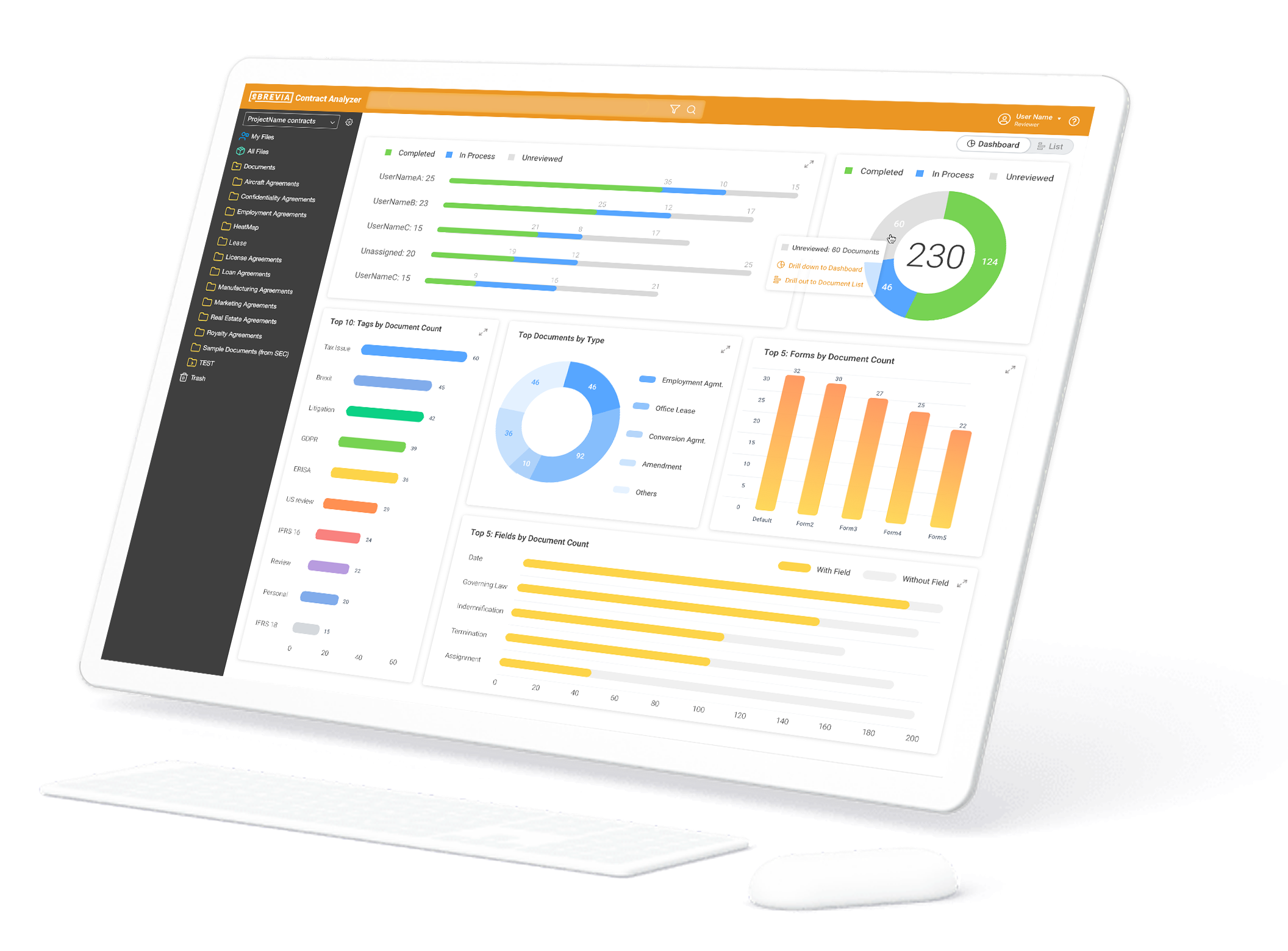
eBrevia Contract Analyzer helps legal teams move from unstructured contracts to organized legal data.
Teams can create a project, upload documents, select the fields they want to review, and use AI to extract relevant contract information. Reviewers can then check the extracted language against the source contract, make changes, add notes, assign documents, track status, compare provisions, and export results.
This gives legal teams a more structured way to handle large document reviews without losing lawyer oversight.
For law firms, eBrevia can support diligence projects where speed, accuracy, and reporting matter. For in-house legal teams, it can support repository analysis, renewal tracking, obligation review, and post-signature contract visibility.
How eBrevia
Contract Analyzer helps
legal teams?
Common questions legal teams should ask before choosing a platform.
Does the platform extract legal-specific clauses, or does it only summarize contracts?
Can reviewers verify extracted language against the source document?
Can the system handle large document sets for due diligence or repository review?
Can review forms be customized for different contract types and projects?
Can the platform identify duplicates and similar documents?
Can reviewers compare the same provision across multiple contracts?
Can the final results be exported into a usable report?
Why choose eBrevia Contract Analyzer?
eBrevia Contract Analyzer is built for legal teams that need to analyze contracts at scale.
It helps teams extract specific provisions, organize review around project-specific fields, validate results against the source document, compare similar agreements, and export structured reports.
With eBrevia, legal teams can reduce manual extraction, improve consistency, and create a clearer path from contract review to final work product.
-
AI contract analysis software helps legal teams extract and organize important information from contracts. It is commonly used to identify clauses, dates, parties, obligations, risks, and other contract data across a document set.
-
AI contract review is often focused on reviewing one contract before signing. AI contract analysis is usually focused on extracting and comparing information across many contracts, often for due diligence, repository analysis, or reporting.
-
Yes. AI contract analysis software can help legal teams review large contract sets for assignment rights, change of control clauses, termination provisions, renewal terms, indemnity obligations, limitation of liability, and other key terms.
-
Yes. Legal teams should be able to verify AI output before using it. eBrevia Contract Analyzer allows reviewers to check extracted language against the source document, edit results, add notes, and mark documents through the review process.
-
Yes. Contract analysis software can help identify duplicates, group similar documents, and compare specific provisions across agreements. This helps reviewers focus on meaningful differences instead of rereading similar language.
-
Yes. eBrevia Contract Analyzer can export structured contract analysis results into Excel, helping legal teams create diligence reports and internal review outputs.
-
AI contract analysis software is used by law firms, in-house legal teams, deal teams, legal operations teams, compliance teams, and contract management teams. Common use cases include M&A due diligence, contract repository analysis, lease review, vendor contract review, and employment agreement review.